
I Need Someone to Talk To When I Feel Lonely
Need someone to talk to? Find practical ways to start a conversation, ask for support and explore human companionship with Get Companion.
Published 5 min read

The workday is over. Dinner is sorted. Your phone has plenty of names in it, but you cannot quite decide who to call.
Perhaps everyone seems busy. Perhaps you have already told the same friend about the same difficult week. Or perhaps nothing dramatic has happened. You simply want someone to ask how your day went and stay for the answer.
When you need someone to talk to, start with a person you trust and make a small, specific request. Ask whether they have time to listen, say what you need from the conversation, and choose a format that feels comfortable. A companionship service is another option for everyday conversation, alongside the relationships you already have.
Why you can feel lonely around other people
A calendar full of meetings does not necessarily give you a place to speak openly.
You might spend hours answering questions at work without anyone asking how you are doing. You might enjoy a family gathering and still leave wishing you had spoken honestly to one person.
The World Health Organization describes loneliness as the distress that comes from a gap between the connections people have and the connections they want or need. Social isolation is different: it concerns having too few relationships and interactions. That distinction explains why being surrounded by people can still feel lonely.
Source: WHO social connection Q&A
WHO’s 2025 global findings put loneliness at approximately one in six people worldwide. This is a global estimate, rather than a figure for India or Get Companion users.
Source: WHO Commission news release
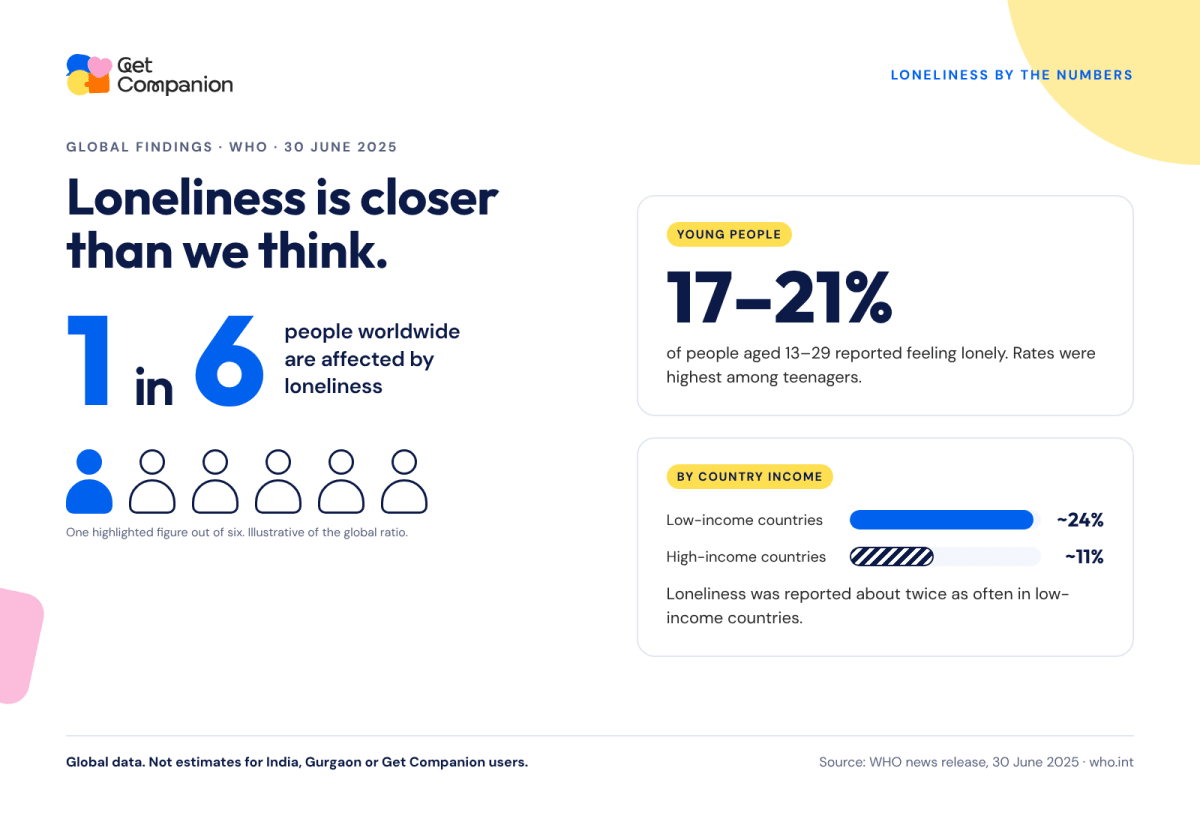
Text version of this image
Loneliness is closer than we think. Global findings from WHO, 30 June 2025.
1 in 6 people worldwide are affected by loneliness.
Young people: 17–21% of people aged 13–29 reported feeling lonely. Rates were highest among teenagers.
By country income: about 24% in low-income countries and about 11% in high-income countries. Loneliness was reported about twice as often in low-income countries.
Global data. Not estimates for India, Gurgaon or Get Companion users. Source: WHO news release, 30 June 2025.
Work out what you want from the conversation
Before opening another app, try finishing this sentence: “Right now, I would like someone to…”
Your answer might be “listen while I talk about work.” It might be “keep me company for a while” or “help me think through a decision.”
Those are different requests. Naming yours gives the other person a better chance of meeting it.
If you want to be heard, you can say, “I’m not looking for advice just yet. Could you listen for a few minutes?” If you would rather have a light conversation, say that too. You do not have to share something deeply personal to deserve company.
Send a message that is easy to answer
“Hey” can leave both people wondering what comes next. A specific invitation gives the conversation somewhere to begin.
Try one of these:
“Are you free for a short call this evening? I’ve had a rough day.”
“Could we catch up this weekend? I miss talking properly.”
“Nothing urgent. I could use some company. Do you have time tomorrow?”
The other person may not be available. Ask about another time, or reach out to someone else. A delayed reply tells you about their availability; it cannot tell you your worth.
If speaking feels difficult, begin with a text. You can move to a call when you feel ready.


Swipe to see all 6
Choose someone who respects your boundaries
A useful conversation leaves room for your pace. You can pause, change the subject or say that you would rather keep a detail private.
Pay attention to how the person responds. Do they let you finish? Can you disagree without being pressured? Are you comfortable saying no?
When considering a paid service, check the price, session format, privacy terms and reporting process before starting. Share only what you feel comfortable sharing. You do not owe anyone financial information, passwords or personal documents in exchange for being heard.
Where Get Companion fits
Get Companion focuses on human companionship: having another person available for conversation and company. Its company profile describes chat, calls and in-person interaction. Check the platform for current formats, availability and terms.
Source: Get Companion company profile
For someone who wants a conversation outside their usual circle, this may be an option worth exploring. It can sit alongside calls with friends, time with family and activities in your community.
Companionship has a different role from clinical care. If distress persists, affects everyday life or feels difficult to manage, speak with a qualified mental health professional. A companionship session should not be presented as treatment or emergency support.
Give the next conversation a place in your week
After a conversation, ask yourself what you would like more of. Was it the chance to speak honestly? The shared laugh? Having someone remember a small detail?
Use that answer to choose your next step. Arrange a regular call with a friend, return to an activity you enjoy, or explore another conversation.
There is no need to solve your whole social life tonight. You can begin with one message: “Do you have a little time to talk?”
Frequently asked questions
Who can I talk to when I feel lonely?
A trusted friend, relative, colleague or community contact can be a starting point. A human companionship service may also offer everyday conversation. Choose someone who respects your boundaries and is clear about the support they provide.
What if I have nothing important to say?
You can talk about an ordinary day, a film, a hobby or something you noticed on your way home. Company does not require a serious problem.
Is companionship the same as therapy?
Companionship centres on conversation and shared time. Therapy is professional mental health care delivered by an appropriately qualified practitioner. Choose support according to what you need.
